

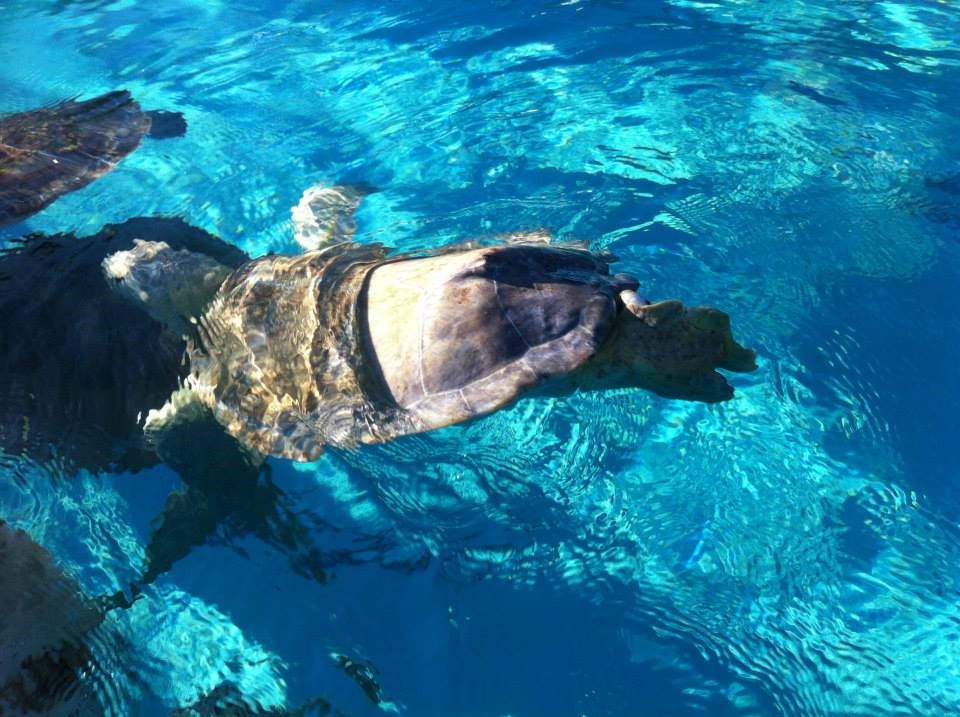
 You’re probably familiar with the danger humans pose to sea turtles—from plastic waste and fishing lines to damage from boat propellers—but have you heard of “bubble butt”?
If you take the fascinating 90-minute tour of the Turtle Hospital in the Florida Keys, you’ll not only learn about this human-created problem, you’ll meet the green sea turtle whose devastating injury gave rise to that name.
Hit by a boat, Bubble Butt’s shell at the tail end has warped into a lump filled with tiny air bubbles. The result is that Bubble Butt’s rear floats on the water; he cannot dive to find food and swims around his tank with his rear shell on the surface and his head several inches below. To help with his buoyancy (and that of other, similarly damaged turtles at the hospital) weights can be glued to the shell. Unfortunately, the weights can fall off, so affected turtles can never be released back into the wild.
Bubble Butt is just one of the dozens of sea turtles cared for at the hospital, which is housed in an old motel where the former outdoor swimming pool is now a salt-water home to several large, permanent residents. In other, round tanks, turtles are healing from operations, amputations, and shell damage. Some of these patients will be released into the wild; some will never leave. Turtles who have eaten trash develop gas that causes them to float—like Bubble Butt—and can be released after the trash is removed by extraction through the mouth and/or the liberal use of laxatives. Turtles who have lost just one flipper to entangled fishing gear can survive in the wild with just three flippers. Those whose shells were split by the impact of a boat or the slashing blades of a propeller will be returned to the sea after the shells, held together by metal bands glued in place with dental glue, have healed sufficiently. Turtles who suffer from the turtle disease fibropapillomatosis, which causes large tumors, must be kept for a year after the tumors are surgically removed to ensure they are disease free.
The Turtle Hospital will take in any injured sea turtle and relies on donations and the ticket sales for tours. It is a not-to-be missed peek into a necessary and important animal rescue service. Your children will be as fascinated as you are!
If you spot a sick or injured Sea Turtle in Florida, contact the Florida Fish and Wildlife Conservation Commission at 1-888-404-FWCC (*FWC or #FWC on your cell phone) or the Turtle Hospital’s 24-hour hotline at 305-481-7669. The Turtle Hospital will let you name the turtle!
Take-a-away: thousands of green sea turtles are damaged or die each year from the trash we dump into the oceans and the boat and ship traffic in their habitats.



 Saving The Places
Fantastic work, we are to blame for so much injury and destruction to marine life, its good to know some of us care enough to try and do something about it.
LikeLiked by 1 person