Home » 2020 (Page 4)
Yearly Archives: 2020
Why Buy Carbon Offsets
 In addition to doing everything you can to reduce your carbon footprint and to get businesses and our government to reduce theirs, you can also offset the rest of your carbon usage by buying carbon offsets for the 20-30 metric tons of carbon you still generate. Fortunately, this is also easy and quick to do. For a few hundred dollars you can offset the carbon you still emit by supporting low carbon projects throughout the world that will benefit local people and reduce global emissions at the same time.
I wanted to offset the travel my family did to all get together for the holidays. It took me 20 minutes to research projects that made sense to me and then I gave the offsets to each member of my family as a gift and to introduce them to this concept. They got it. They had not done it before but I bet they will in the future.
There are only 4 steps between you and carbon neutrality. This does not mean you stop trying to reduce your own emissions – that is still key – especially for Americans who use the most energy per capita on the planet. Here is all you have to do:
- Go to https://www.goldstandard.org/take-action/offset-your-emissions – they help ensure your investment is going to vetted organizations. This is important.
- Scroll down to a project(s) you like. If you don’t want to have to sort thru 20+ possible choices, here are 2 to consider:
-
- Climate+ Portfolio of Projects for $11/Metric tonne
- Solar Cooking for Refugee Families for $15/Metric tonne
- Select the number of tons you want to offset. Click “Add to cart”.
- Go to cart, check out, and pay.
Try it. There are many projects overseas that deserve your support and we cannot do it all here. We need to create a global behavior shift, not just a local one. (Thanks to K. Crandell)
Switch electricity supplier to 100% solar or wind

Photo by KML on Pexels.com
Last week we discussed some basic ideas of how to reduce your carbon emissions. To reach the goal of slowing down the heating of our atmosphere, we also need to take a look at how much carbon we generate and find even more ways to reduce it. Our carbon dioxide emissions per person are about 3 times the world average so we can be real leaders in becoming more efficient and far less damaging to the atmosphere.
I suggest you take the time and calculate your carbon footprint – it is an informative process that will take about 20 minutes and will tell you where to focus your efforts. You will probably find that your main uses are for transportation (fuel) and for heating and cooling your home (usually with natural gas, oil, coal, or electricity – generated from a range of fuels). Each of us has a big opportunity for reducing our carbon footprint by reducing our dependency on fossil fuels and moving toward solar and wind generated electricity.
There has been a big effort over the past decade to deregulate utilities to allow you more choice in what energy supplier you use. Many states have deregulated their energy suppliers. They include New York, Pennsylvania, Maryland, Delaware, Massachusetts, Connecticut, Maine, New Hampshire, New Jersey, Illinois, Texas, Virginia, Rhode Island, D.C., and Ohio. https://www.saveonenergy.com/state-information/
After deregulation, we electricity consumers lucky enough to be in one of those states have been able to change suppliers. Our local utility still delivers electricity to our home but we stopped buying our energy from them since they largely generate energy from fossil fuels (coal, oil, and natural gas) and nuclear. We decided to switch to solar and wind suppliers. This took only a few minutes to do – all online. For the past 10 years we have used various vendors at a cost comparable to our local utility. If you are in one of these states you can probably do this too. Check out Inspire, Green Mountain Energy, Clean Choice, etc. There are dozens of firms who can supply you with clean and renewable energy. This is probably one of the easiest things you can do to lower your carbon emissions and help accelerate the movement toward renewables.
This past year another option has become available to us living in Maryland – you might want to check it out where you live. There are community solar firms who you can sign up with who build local solar arrays and sell you their electricity. The one we signed up with is Neighborhood Sun, but there are others – check them out.
Both options reduce the burning of fossil fuels and are very simple to sign up for. We also found out that it is easy to switch back to the utility if desired. We have never had a disruption in service and have dramatically lowered our carbon footprint.
Reduce Your Energy Usage on a Local Level

Photo by Pixabay on Pexels.com
In addition to Federal action on a Carbon Fee (discussed in last weeks blog), there are many steps that you can take to reduce your energy footprint and your out-of-pocket costs. This is important especially if you are relying on fossil fuels for some or all of your energy. It’s also important to take these steps not just because they will reduce your carbon emissions and will lower your costs, but because it will send a message of action and hope to your neighbors, friends, governments, and businesses all across the country.
Let me put this in the context of a few of the things that we did in our home – so I know first hand that they can be done.
Once our kids moved out of the house, we realized we did not need so much space. We did not want to have to clean or maintain it all – or pay a mortgage on it. We sold that home and bought a nice home that is half the size. No mortgage, no exterior maintenance (condo), and a lot less cleaning. The new home is much closer to most everything we do so we are using a lot less gas and are considering going to one car. Our quality of life has, in fact, increased with a lot less time going into household chores, filling up the gas tank and driving. Furthermore, because of all these steps, we cut our emissions and electrical costs in half – and got rid of the mortgage. By the way, the view is awesome.
We then had our local utility, BG&E, come in for $100 to do an energy audit. They replaced our light bulbs with more efficient ones, installed a water reducer in the showers and sinks, and found several areas where we could make our living space tighter. They also set us up for energy saving days where they can manage our hot water heater and electrical supply. This has saved us $100s of dollars per year with no real inconvenience.
We also replaced our HVAC system to a much more efficient system, insulated our attic crawl space, and replaced our windows. Our home is now quieter and snugger and our electricity costs have dropped significantly – again.
Heating and cooling our homes and offices is one of the greatest sources of greenhouse gas emissions and something we can reduce by taking action – today. Call your local utility for an audit and advice on saving money and saving the climate. It will be well worth your time.
Carbon Fee – a call for action on a national level

Photo by Ion Ceban @ionelceban on Pexels.com
I was “in” the fossil fuel industry for years, so I know a little bit about it. They have been very successful in meeting our energy needs – which is great. They have accomplished this because we helped them to meet our energy needs. The Federal government helped out the fossil fuel industry by incentivizing them to a great deal. That is how corporate socialism works. But let’s all acknowledge that we and the fossil fuel companies have been getting away with dumping their/our combustion waste products into the air for free for over 100 years. This may have been understandable and beneficial when there were far fewer people on the Earth. Today this practice has caught up with us and we are now severely damaging our health, our economy, and our future.
Fortunately, there are other economical and cleaner energy options available to us today. We can stop burning these valuable resources and either use them for other purposes or keep them in the ground as a strategic resource in case we need them in the future. Hopefully, by then we will have learned how to use them with less harmful effects to our health and our future.
One way to accomplish a transition from our current, near total dependence on fossil fuels to a much greater use of clean and renewable energy alternatives is to implement a national “carbon cap” or a “carbon fee” to pay for the real and hidden costs to society of using these dirty fuels. Applying true costs to fossil fuel usage will allow the market to implement a smooth transition to alternatives. Last year we saw the majority of economists across the political spectrum endorse this strategy. After many years of debate they have concluded that “a carbon tax offers the most cost-effective lever to reduce carbon emissions at the scale and speed that is necessary”. They went on to say that “by correcting a well-known market failure, a carbon tax will send a powerful price signal that harnesses the invisible hand of the marketplace to steer economic actors towards a low-carbon future”.
What are we waiting for? We just need to do it. Even Exxon/Mobil has supported this approach – of course the devil is in the details… the speed that the fee is implemented will be hotly contested. But the first thing we need to do is to get all the voices at the table to encourage the passage of one of these macro-economic tools ASAP. To get involved you can join/support the Citizens Climate Lobby, Sierra Club, Environmental Defense Fund, The Nature Conservancy, or others and keep pushing your representatives to support the passage of one of these carbon emission solutions (bills). This needs to happen now and we need to hold our representatives in DC accountable. I hope that each of you will get even more active today and then vote with climate issues foremost in your mind.
Tuesdays with Tillman
 Climate Action
Over the next 12 weeks, I will be posting a series of personal blogs, videos, and polling questions. They are designed to share some of the things that I do and that you can do to help us all deal better with the climate challenges we all will be facing for the rest of our lives. The sooner we take action the less our children will suffer.
Tuesdays with Tillman will be a series of blogs about what we can do as individuals, at home, at work, and on a state and national level to reduce our emissions of greenhouse gases. In my book, The Big Melt, one of the main characters created a list called “Ten Steps for a Cooler Climate”. It is a good list, but I have modified it a little and added links to help you take action. Thanks to Ken Crandell for some of the links and images.
Many of these ideas are micro steps – but they are important and I will discuss them along with some major macro steps that are also needed to slow down our changing climate. If you want a more comprehensive list get the book Drawdown by Paul Hawken. If you don’t like my list, put together your own list and be sure to share it with me and your friends. We need each other to accomplish meaningful progress.
I hope you will be part of this journey and help to spread the word by Sharing what you like with your friends. Be sure to Like our page on Facebook and follow us on LinkedIn, Instagram and Twitter to ensure you get these videos, blogs and posts. Thanks for all that you do already.
Sketches of The Big Melt
I knew Bert Moore for over 3 decades. Aside from his work for the US government he loved biking and sketching. I’ve seen his work in lots of places and always admired the relaxed style he used to bring life to subjects. I was honored to spend some time with Bert during his last days. He was excited about trying to capture the main characters in my book, The Big Melt. I think he did a pretty darn good job of it. I would like to share these images with you as a tribute to the man and his art.

Marley Jones is the lead protagonist in The Big Melt. He is a skate-boarder as shown here by Bert’s sketch. He is also a teenager, ready to get on with his life – and then all hell breaks loose in the form of a whole slew of climate change impacts. Here he is trying to relearn his favorite form of transport on melting streets.

Ranger Max, one of Marley’s mentors, is sneaking up on a meadow at dusk to watch the famous mating dance of the woodcock. His well planned outing and his wooded park are disrupted by a catastrophic invasion of insects, moving north with the warming climate.

Sam, who along with his father are the main antagonists in The Big Melt, blasts away in this sketch at the competition as drones try to deliver packages to his customers.
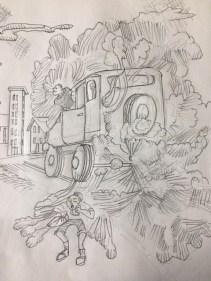
Sam also converted his hummer to rolling coal so he can blow exhaust on bikers, walkers and hybrid owners. This has happened to me once and it took a few minutes for the air to clear enough to drive safely.
 Saving The Places