Home » 2016 (Page 3)
Yearly Archives: 2016
BikeHoward and Bike Safety
 BikeHoward – A Big Step Forward.
I am very much in favor of BikeHoward – the Bike Plan for the County – being voted on by our county council this Monday. I strongly encourage you to support its approval and implementation. Let your council representative know this weekend of your support as well (councilmail@howardcountymd.gov). More trails and safer ones will help get more people (more…)
My Favorite Places – Lake Elkhorn Outcrop Offers a Journey to the Center of the Earth

Rock outcroppings offer us a peek at the normally hidden, inner world of our planet. In the Maryland Piedmont good outcrops are few and far between. In Howard County they occur along the major rivers that border the county. Good exposures to the inner workings of the earth can also be found in the quarries at Savage (gabbro), Marriottsville (marble), and Old Ellicott City (granite). Collectively these outcrops provide us with a record of a long history of plate tectonic movements driven by major thermal convection cells deep in the mantle of the earth.
The black gabbro outcrops along the eastern edge of our county are remnants of oceanic (more…)
800 Trout
 February/March is that time of year. That time of year when the Maryland Department of Natural Resources (MDNR) begins stocking our lakes and streams with thousands of 12 inch rainbow trout. I know this because all of a sudden the fishermen are out in droves. Trying to catch the 800 trout that were dumped into Lake Elkhorn last month. More will be stocked this month.
In Howard County, MDNR stocks Lake Elkhorn with 2000 trout, Centennial Lake with 2500, and they also stock the Patapsco River with (more…)
Million Frogs Calling
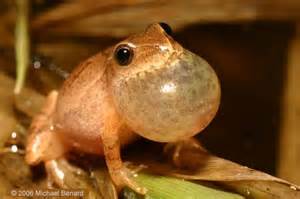
Image used by permission from Michael Benard’s Spring Peeper Page
I wonder at times if the suburban area in which I live is more biodiverse today, or less so, relative to the farmland it once was. Has the onslaught of development left our natural green infrastructure – that we depend on for clear water, clean air, and healthy soils – better or worse off than 50 or 100 years ago? Yes habitats have been reshaped a great deal in the last 500 years, but is it possible that we are doing a (more…)
Floating Through Coral
 While on a recent snorkeling trip I lost myself in the submarine habitats that skirted a small island in the Caribbean. I floated by forests of pink reindeer coral followed by a distinctly different area of brownish orange staghorn corral and then a multihued collection of fans waving as I passed. The fish population was ever-present and diverse, ranging from large, colorful parrot fish and jacks to Sergeant Majors and grunts. I loved watching Trunkfish blow away the sand in search of food and to see pencil-like Trumpetfish hovering near fans. An octopus skittered around on its tentacles right (more…)
New Post – A Sense of Place
 I have spent a good deal of the last 10 years defining and describing A Sense of Place as that concept relates to the village, county, and watershed where I live (see The Chesapeake Watershed). I have also attempted to do it for places that I have visited, worked, and lived (see Saving the Places we Love). It is a daunting task. I hope I have achieved it, in some small measure, or at least inspired others to try to define their community for themselves.
I am now involved in another attempt to do this. This time through community storytelling. The Howard County Conservancy is hosting two events (more…)
Ranger Max Considers Trail Etiquette – Guest Post
 Max has been a Volunteer Ranger at Maryland’s Patapsco Valley State Park (PVSP) since he retired back in 2010. He made a personal goal of hiking each major trail in the park for the fun of it and so he could advise park visitors which trail best meets their needs-Easy? Scenic? Bikeable? Peaceful? Accessible?
One of the more frequently asked questions is about trail etiquette, especially when it comes to the encounters between equestrians, mountain bikers, dog walkers? The Rangers’ usual reply involves an understanding of right of way and park rules. We will discuss these one at a time. (more…)
Plant Meadows, Save Bees – Post by Mark Southerland

Everyone knows about the colony collapse disorder affecting honeybees imported from Europe, but few know that Maryland has at least 425 species of native bees ready to pollinate our plants, if we can reverse the loss of native meadows. The United States is home to about 4,000 native bee species, none of which live in hives nor do most sting. As Sam Droege of USGS says, “honeybees are from Mars,” and constitute only 1% of our local bees. Native bees deserve our attention for both ethical and utilitarian reasons. In essence, this native bee fauna is responsible for the wonderful diversity of flowering plants that we enjoy. In essence, the amazing architecture of flowers evolved to attract bees and other pollinators. In addition, many native bees are important pollinators of crops such as (more…)
Blizzard 2016 – Shrews, moles, minks, chipmunks, squirrels, feral cats, beaver, muskrats, coyote, fox, and all the birds – where do they go in a storm?
 I was out and about this morning, still seeing and hearing signs of life, but wondering where all our feathery and furry friends will be spending the next few days. Some may have flown away, but most stay close by. As the snow piles up, many of them may be confined to their burrows but others will be making intricate pathways beneath the snow. Pathways that we might never see. I bet the weather below the snow will be milder that the windy conditions we will be experiencing. Here is a photo of tracks that I followed for hundreds of feet along the banks of Lake Elkhorn and which then took a ninety degree turn and shot out straight across the lake.
 In addition to all the bird and mammal tracks I saw along the paths and on the snow covered, frozen lake, I saw this interesting trail capturing the movement of what I think was probably a duck from what is left of the open water onto the ice and then back again. Must have preferred the open water to the frozen water. Probably a mallard, since I don’t see any hooded merganzers, ringnecks, or redheads hanging around. I am also wondering how long it will be before the aeraters and their open waters get covered up. (more…)
Walking with Eagles
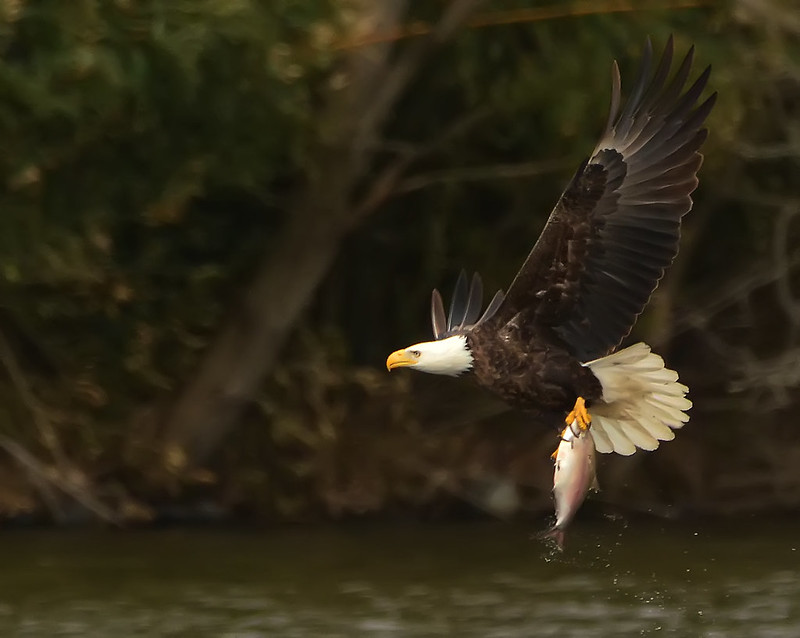
 Like many others, I have been dropping by Wilde Lake here in Howard County to watch the eagles. I have counted as many as 8 bald eagles at a time. They have been hanging out here for the past two weeks! That is a rare event for this area. They perch in the tops of some of our largest trees, such as the champion Swamp Oak at the west end of Wilde Lake. They also fish and soar back and forth over the lake at both low and high elevations. It’s a blast!
My enjoyment has continued online through Michael Oberman’s photographs. Michael is a world class photographer who lives locally and spends a good deal of time photographing wildlife around the nearby lakes. If you like the images shown here, check out his Flickr site.
 On our walks we are treated with great views of mature bald eagles with their bright white heads and tails as well as immature eagles who had not yet developed the white plumage – it takes up to five years. They are all fun to watch and we point them out to everyone we pass. A number of photographers patiently wait on the banks of the lake, trying to get the perfect shots to document the unusual sightings of so many eagles here on these suburban lakes.
Today we saw two eagles over Lake Kittamaqundi, and on Friday I saw one over Lake Elkhorn. What a joy! Many of the people I have encountered around the lakes are wondering where these great birds come from. I have heard a range of explanations – I love multiple working hypotheses. They could have flown over from the nesting population on the nearby reservoirs – especially since one of them has very low water levels at present. There evidently has been a fish kill recently in Wilde Lake as well – which would attract these scavengers. In addition to the resident eagles that spend the entire year here in the Chesapeake Watershed, others that summer in Canada come here for the winter. Maybe they are finally showing up now that the north country is getting snow and colder weather.
 The presence of so many of these great birds is a testament to how we as a society have learned to coexist with other forms of life on this planet. Thanks to Rachel Carson’s Silent Spring, published in 1962, as well as a loud outpouring of voices from across the country, and a responsive, bipartisan Congress, we collectively took the steps that reduced the indiscriminant use of pesticides that was causing a decline of our great raptors and a host of other birds. We owe those people back in the 1960s a major debt of gratitude for speaking out and changing what was our accepted but misuse/uninformed use of chemicals. By taking action over the past 4 decades, the eagles have come back.
One day last week, right after a rain, I did not see any of the eagles feeding. This may have been due to how brown the water was after the storm. I wonder what eagles do when they cannot see fish in dirty brown water. A lot of debris and silt must have washed off our backyards and into the streams. The silt made it hard to see into the water and the debris covered the surface of the lakes with a wide range of plastic bottles and trash – some of which must have looked like fish…..
I found this to be another reminder of how each of our actions do impact others and the environment that we live in. It is important for all of us to realize this and take actions like putting in stormwater controls in our backyards and controlling all of our trash so it does not end up floating on the lakes and in our rivers. I hope these eagles flourish and hang around so all of us can enjoy their majesty. I also hope all of us appreciate them enough to go the extra mile in protecting their habitat.
Take-a-way: Consider putting in rain gardens and reducing the stormwater runoff from your land. Carefully manage your trash. Go out and enjoy the eagles. Best time for viewing the eagles is 7 to 9am and 2-4pm.
 Saving The Places